The Swedish Rite — a Masonic path many in the West never hear about
Most Freemasons in the English-speaking world grow up around Craft Lodges, York Rite, or Scottish Rite. But in Northern Europe, an entirely different Masonic system has been quietly and consistently practiced for over two centuries: The Swedish Rite.
Developed in Stockholm during the late 1700s and finalized in 1800 under Duke Carl of Södermanland—later King Carl XIII—the Swedish Rite is worked today in Sweden, Denmark, Norway, Iceland, and Finland. Each country has its own sovereign Grand Lodge, yet all work the same rituals, under the same structure, and with the same philosophical foundation.
What makes the Swedish Rite unique is that it is one continuous, unified system.
There is no branching into side bodies. No hopping between appendant organizations. A Brother enters and progresses within the same Order from beginning to end.
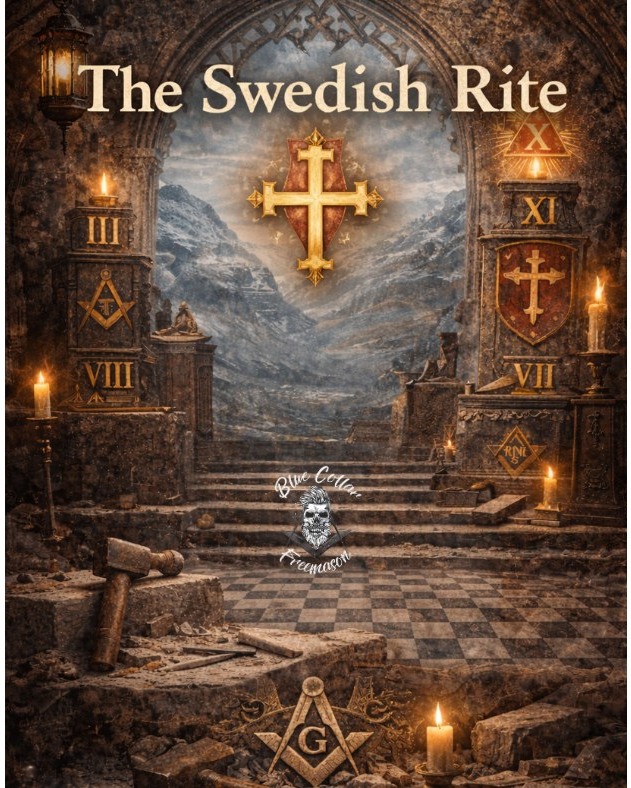
The system consists of eleven degrees, grouped into three divisions:
• St. John’s (Craft) Degrees I–III – Apprentice, Fellow Craft, Master Mason
• St. Andrew’s Degrees IV–VI – Scottish degrees unique to the Rite
• Chapter Degrees VII–X – culminating in deeper philosophical instruction
• XI Degree – Knight Commander of the Red Cross, almost exclusively for Grand Lodge officers
Progression is slow and intentional. A Brother may take 12–20 years to reach the 10th degree. This isn’t about collecting titles—it’s about formation. Each degree builds directly upon the last, often in a separate lodge room designed specifically for that degree, reinforcing that each stage stands on its own.
Another key distinction:
The Swedish Rite is explicitly Christian.
Membership requires a profession of Christian faith. The symbolism, obligations, and lessons are built to deepen a Brother’s understanding of Christianity, morality, charity, and personal responsibility. The Rite openly frames Masonry as a tool for spiritual development—guiding a man through timeless questions:
Where do I come from?
What is my task in life?
Where am I heading?
Even for those of us who do not, and cannot, participate in the Swedish Rite, it deserves recognition. It stands as a reminder that Freemasonry is not monolithic. Different cultures, histories, and traditions have shaped different legitimate Masonic expressions—each answering the same human need in its own way.
You don’t have to practice a Rite to respect it.
And you don’t have to agree with every structure to appreciate the discipline behind it.
That, too, is part of Masonic education.